
Ritualized Coins
Can common coins, used in rituals, challenge what, and how, we value?
At The Liberty Cap Foundation one of our favorite activities is interviewing the people who have applied for our 1794 microgrants. We certainly receive grant applications that directly address numismatics, but we also receive applications that treat coins primarily as objects connected to, and sometimes as part of, culture and ritual.
Contemplating these projects prompted us to wonder about how and when coins primarily become objects whose use and meaning supersedes, and in some cases overwrites, their face value; and given the US as the locus of the projects, it also made us think about the many different peoples–and their traditions–who populate the United States. In a country whose beginnings depended on influxes of voluntary and involuntary immigrants, these varied traditions intermingled to form–quite literally–some of the foundations of the US.
The cultural, often ritual use of coins forces us to consider a series of questions and to confront our own deep-seated associations of value and practice: what kinds of power have people believed coins hold, beyond their monetary or historical value? What happens when we consider coins through the lens of archeology? By starting with the useful opposition provided by “The Archeology of Money,” coins can be used in a “ritual context” vs. in the “economic sphere.” Same coin. Different use. Does this ritual context accrete power only to the maker who puts the coin to a different purpose, or is ritual context something more communal, a choice of use that changes the importance and meaning of the coin that is recognized by various members of a society? What do 21st century dwellers make of the “ability” of a coin to “protect” when placed inside a wall or in a shoe? How and when do coins collide with superstition, and how might our individual and presentist biases affect our judgment of the “value” of those coins?
Our assumptions about worth and cultural value certainly find confirmation in the spectacular Roman necklace below. Before we even begin to consider the change in use of the coins from economic to ritual context, most viewers of this necklace are stunned by its size and display of gold coins, which would have conferred status and value to the wearer of the necklace. The fact this is an ancient necklace, held by the Metropolitan Museum of Art, made by Romans, and of gold further raises its status.
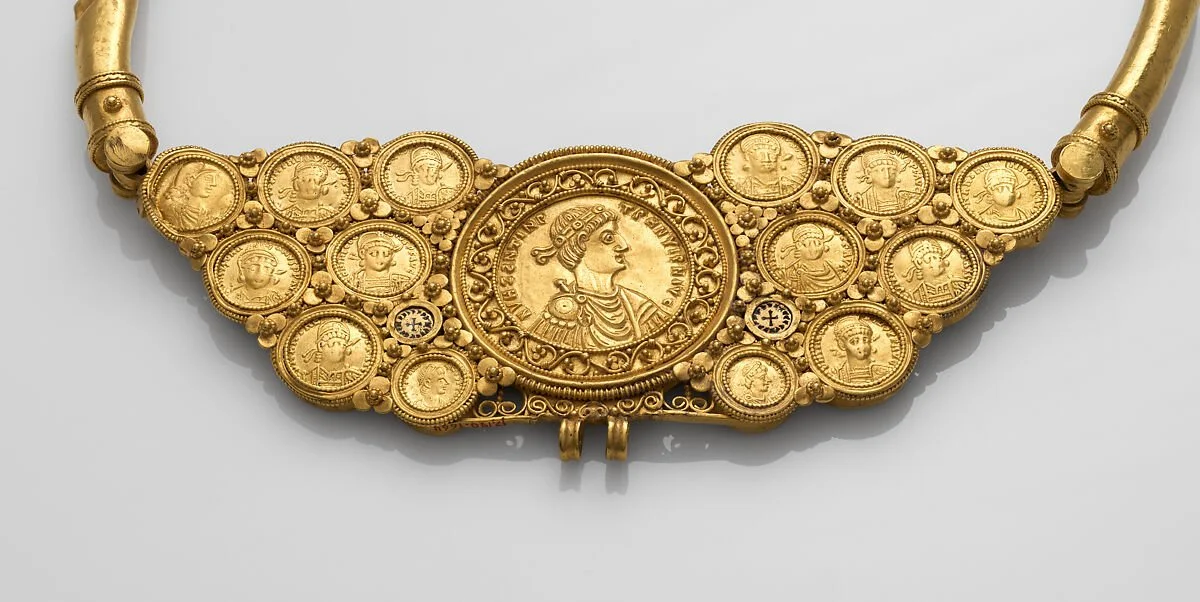
Roman Coin Necklace at The Metropolitan Museum of Art
This impressive Roman necklace repurposes coins for their representational and political power: the necklace’s wearer aligned themselves to the powerbase represented by the emperors on the necklace. As Stephanie Caruso says in “Wearing Coins in Late Antiquity,” part of what Romans would recognize about this necklace is the enduring wealth of their family and of their affiliation with the emperor. While many 21st century viewers might not recognize the affiliation with generational influence, the size and the material attest to how and why it’s in a museum. On some level, without the Roman ritual context, many of us might struggle to think beyond the clear statement this necklace makes of affiliation with power. Most of us could see that wearing this necklace signals the importance of the wearer, even though the central “coin” is in fact “counterfeit”--a medal designed to look like a coin.
So far, we could doubt that there is anything particularly unusual going on with the necklace. After all, most societies read the subtle codes of jewelry and dress. Couldn’t we say that this necklace might be akin to a very beautiful diamond pendant, or to a very expensive Rolex? It is at this moment that something interesting happens to the coins. Ritual context. Caruso explains that “[s]urviving material evidence substantiates that people in Late Antiquity believed that once coins had been turned into jewelry, they possessed prophylactic value. For example, a surviving pierced bronze coin of Justinian I bears a Greek inscription, which translates to ‘Lord Protect the Wearer’.” In this case, the object almost transubstantiates from coin to something akin to religious charm or protection, a practice about which, Caruso explains, the new Christian church did not approve. As different versions of Christianity believe that wine at communion either represents the blood of Christ or that it IS the blood of Christ (consubstantiation vs. transubstantiation), for the Romans, the nature–not just the use–of the coin changed.
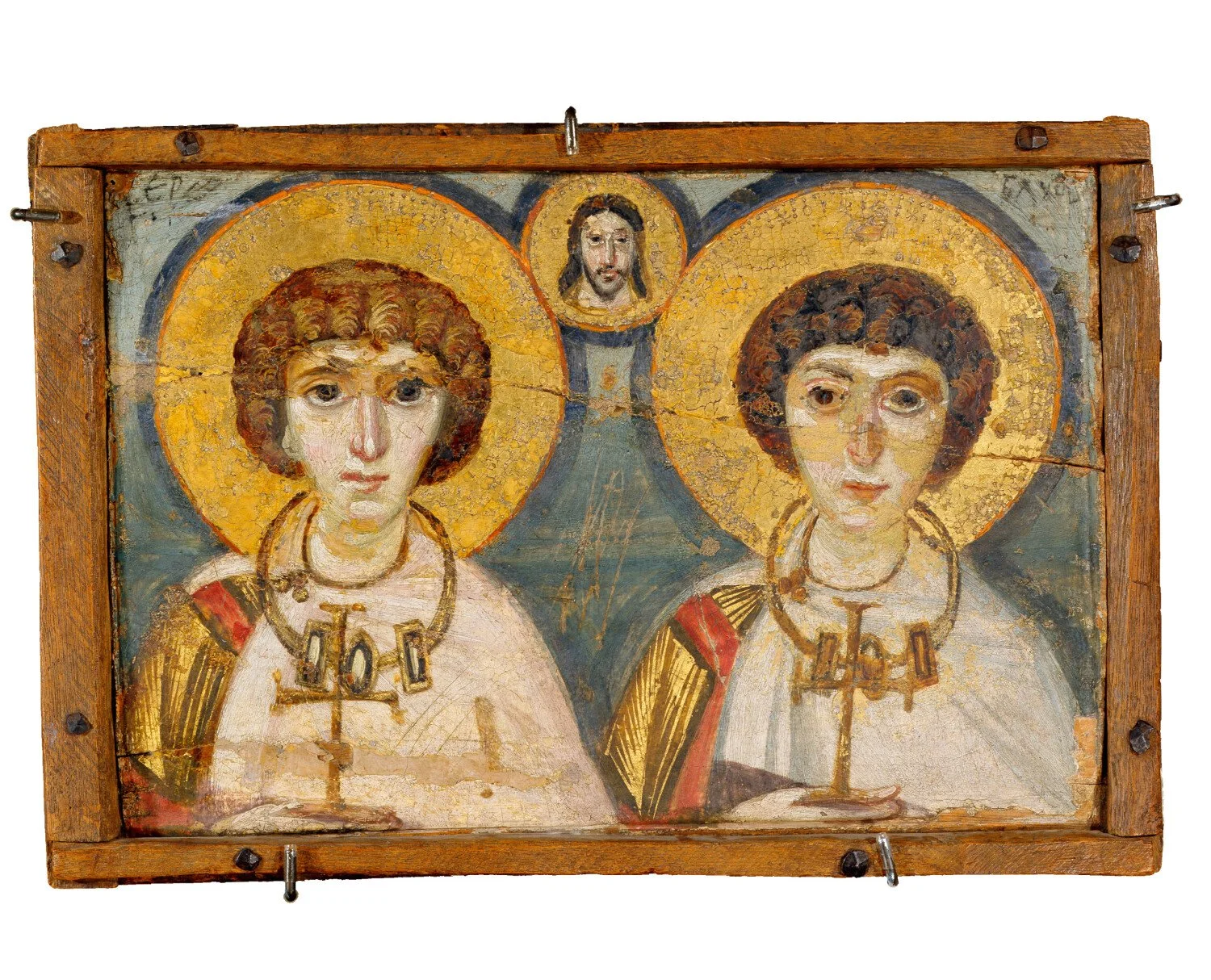
Icon of Saints Sergius and Bacchus, Louvre Museum
Indeed, Caruso presents portraits of early saints in what is now Ukraine, wearing necklaces very close to the Roman one above. This, too, was a practice that the early Catholic church tried to eradicate.
Saints and gold, Romans and emperors: it’s a heady mix, one dependent, I would argue, on associations with rarity and value.
If the rarity, age, and value of coins used in ritual context accounts for part of their appeal, then how do we value or judge “plain old” US cents or British sixpence or Spanish coins used in ritual context? Are the ritual contexts of these coins as appealing as the proximity to the Emperor in the Roman necklace, or does using more common coins somehow become more like superstition, a word often overlaid with connotations of ignorance and class judgment?
In “The Archeology of Money,” Haselgrove and Krmnicek propose that “the scientific development and increasing institutionalization of numismatics as an academic discipline achieved the exact opposite [of emphasizing the importance of context], reinforcing the supremacy of the single object over its context and perpetuating an approach that examined coins detached from the rest of the archaeological evidence with which they were associated” (237 a). Pushing against numismatics’ emphasis on the rarity and worth of specific coins, archeologists value the use of all coins, no matter their rarity. The authors argue that within the United States in the 18th and 19th centuries, almost all peoples used coins beyond their intended/monetary purpose. Given the wide variety of immigrants, voluntary or forced, along with native Americans, the ritual use of coins shows almost all immigrant groups affected by traditions from elsewhere. These intermingled American traditions form–quite literally–some of the foundations of the US, since ritual context extends to items placed within the walls and foundations of buildings.
Rather than jettisoning the ritual context of so-called “common” coins in favor of the beauty or metal of a coin, we can instead consider how the use of these coins attests to fundamental cross-cultural influences in Colonial America and the early US. In this way, no matter the commonness of the coin, its ritual use speaks to the “pluribus” required to be stamped on all coins by the Coinage Act of 1873. Americans are “many,” and we should venerate the cultural and ritual contexts of coins and the people who modified and used them.
Once we attune ourselves to ritual context, we can explore the values overlaid by various cultures onto common coins. In “Hoodoo in St. Louis: An African American Religious Tradition,” the National Park Service explores the rise of hoodoo, also known as conjure or root work, as a way that “[e]nslaved Africans were often forced to become Christians upon arrival in North America. The synchronization of African practices with the Christian religion created Hoodoo among enslaved African Americans.” Hoodoo offers rituals and strategies to battle misfortune and encourage good fortune, including the use of Mercury dimes as charms: “[s]ilver dimes were found in the Winter Kitchen. Silver dimes are used in Hoodoo as protective charms. Other items found in minkisi bundles at Grant historic site were the same items found in similar conjure bundles on other slave plantations.” Enslaved people often fused a variety of African traditions to create their own rituals. One key ritual practice was the making of minkisi bundles (singular, nkisi) bundles, which archeologists have discovered across former plantations. These bundles contained a variety of objects, sometimes including coins.
Indeed, one of our 2024 grantees, Joy KMT, practices conjure work and makes brooms, sometimes with Mercury dimes, showing the extension of these older practices into the 21st century.

Broom made by Joy KMT
As enslaved people and formerly enslaved people combined various African traditions, so did Europeans, and as all groups intersected in the country, so did their ritual practices. Many English settlers would fold or bend coins, and still today in the UK people put a silver sixpence into the toe of a bride’s shoe, a practice that existed in Colonial America. These combined ritual uses of coins across cultures begins to explain the bundles of items archeologists sometimes find in the walls of or beneath the foundations of buildings, which can include horse shoes, pennies, and “witch bottles.” While it may be more comfortable for us to think of these as illustrations of healing magic, these are also considered to be examples of harmful magic. At the early settlement of James Fort, archeologists have found many folded coins, which inhabitants believed would protect them from disease (see image below).
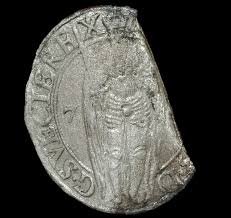
Folded Swedish Ore, found at James Fort
In “The Material Culture of Ritual Concealments in the United States,” Manning exhorts us to change how we think of magic practices: “[i]nstead of viewing evidence of folk magic and ritual as an archaeological anomaly, historical archaeologists begin to approach every historical site and structure- and not just those associated with the African diaspora- with the expectation of uncovering material evidence of magico-religious and secular folk ritual” (77). It is at this point that we should return to our earlier discussion about the ingrained preference many of us have for gold over copper, for Romans over some nameless Colonial inhabitant of, say, Boston in 1781. The place and role of coins exceeded for many of these nameless people what the coin could buy. Indeed, their ability to protect, to act as charms, to make changes in the lives of everyday people meant that the ubiquity of common coins actually opened space for the practicing of other religions than mainstream, 18th century religions. There was organized religion, and there was Hoodoo; there might have been Congregational churches, but there were also ancient cultural practices that asked people to believe that the objects they had access to–bottles, coins, horseshoes, animals–could become more than what they were. Do these widespread ritual uses ask us to consider the freedom of religion in another light?
The use of coins collected over generations to create necklaces is still a practice in Ukraine. One of The Liberty Cap Foundation’s 2025 1794 grant awardees, Tamara Finaly, is a Ukrainian American who created a dukach for a stop-motion animation she directed.
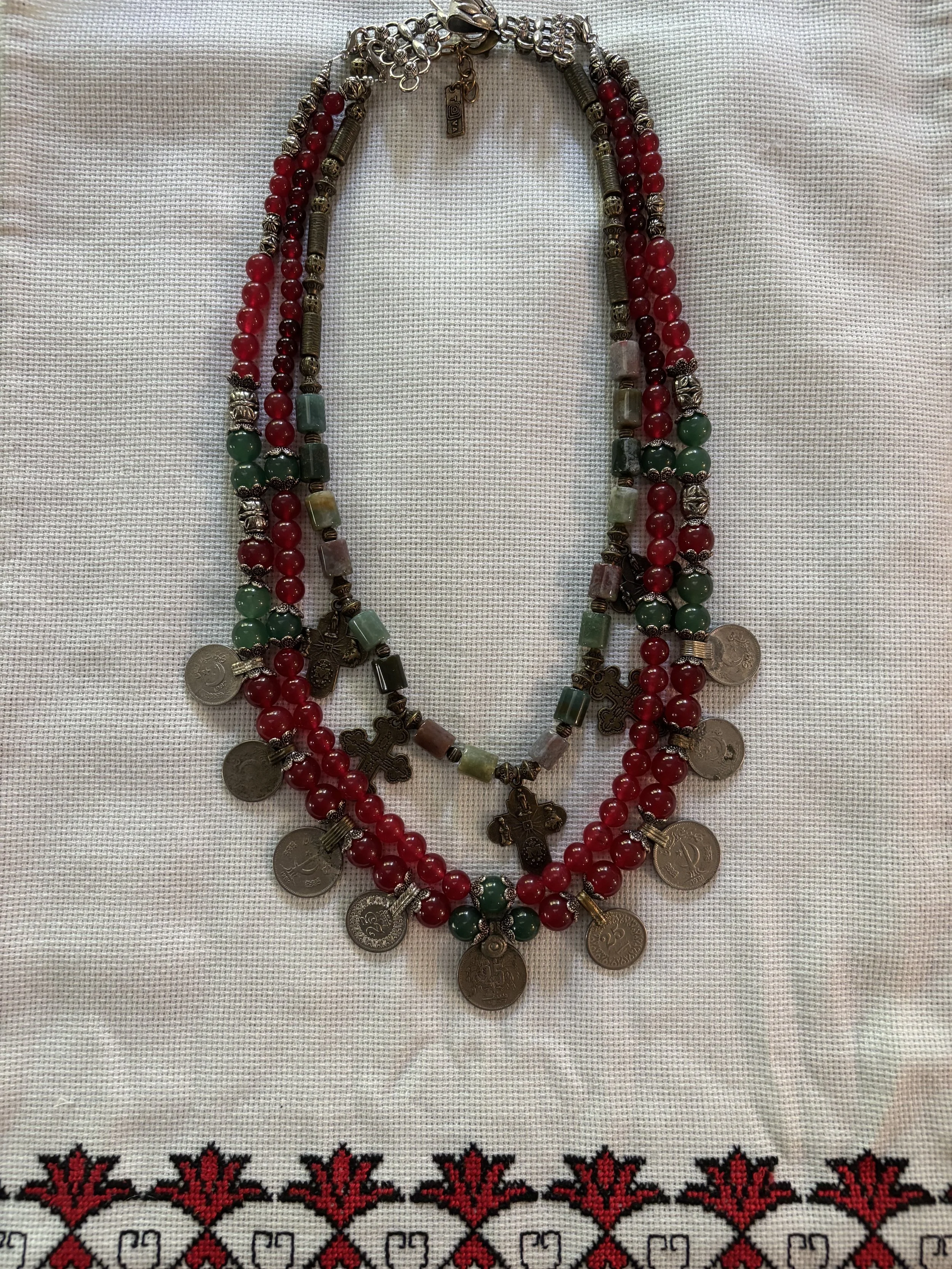
The dukach, the saints, the Roman necklace—these objects echo across millennia, linking not just the important or the well-connected, but people everywhere for whom life can be hard. For them, the objects at hand stand in for our hopes and desires. In the US, where so many have come from elsewhere, the ritual use of common coins speaks to a different kind of wealth than a perfect Sheldon 1: almost all of us can find a penny and turn it into a talisman to protect us from a world that has always exceeded human comprehension.